If you run a partner programme at a software or cloud vendor, you can see what MDF funds each partner claimed last half. You usually can’t see whether the marketing they bought was any good. This piece is for the people who sign those funds off, and for the partner marketers who spend them. The way to find out is to score what the money produced, partner by partner, and compare.
That’s what we built for Microsoft. I worked for Microsoft partners before I started Fifty Five and Five, and we’ve worked with Microsoft since day one. The Partner Benchmarking Tool was the first product we ever built. Until then we only made marketing.
If you’re on the partner side, our Microsoft MDF guide covers what the funds are and how to claim them, and why MDF funds often don’t turn into pipeline covers how they get spent. This post is about what the money produced.
Why is it so hard to measure what MDF funds produce?
The paperwork shows the money was spent. It says very little about the result. Microsoft’s own co-op rules ask partners to keep “proof of execution” documents for 24 months after an activity (Microsoft Learn ). A claim shows that a webinar ran or an ad went out. It doesn’t show whether the landing page behind it worked.
The vendor is also a long way from the sale. Brett Kahnke, a principal analyst at Forrester, wrote that “being one (or more) steps removed from the deal, channel organizations face challenges acquiring the level of detailed data necessary to fully understand the impact that channel marketing provides” (Forrester ). The partner has the customer and the deal data. The vendor gets a claim form.
Then there’s the size of it. A big vendor funds partners in dozens of countries, from multinationals to ten-person firms. Reading every partner’s website and social feeds by hand, then doing it again next quarter, isn’t realistic.
On one of our trips to Seattle, Microsoft’s partner marketing team told us they couldn’t put a number on what their funds bought. They wanted to know if funding a partner got them anything back, and they had no way to check.
What did we build for Microsoft?
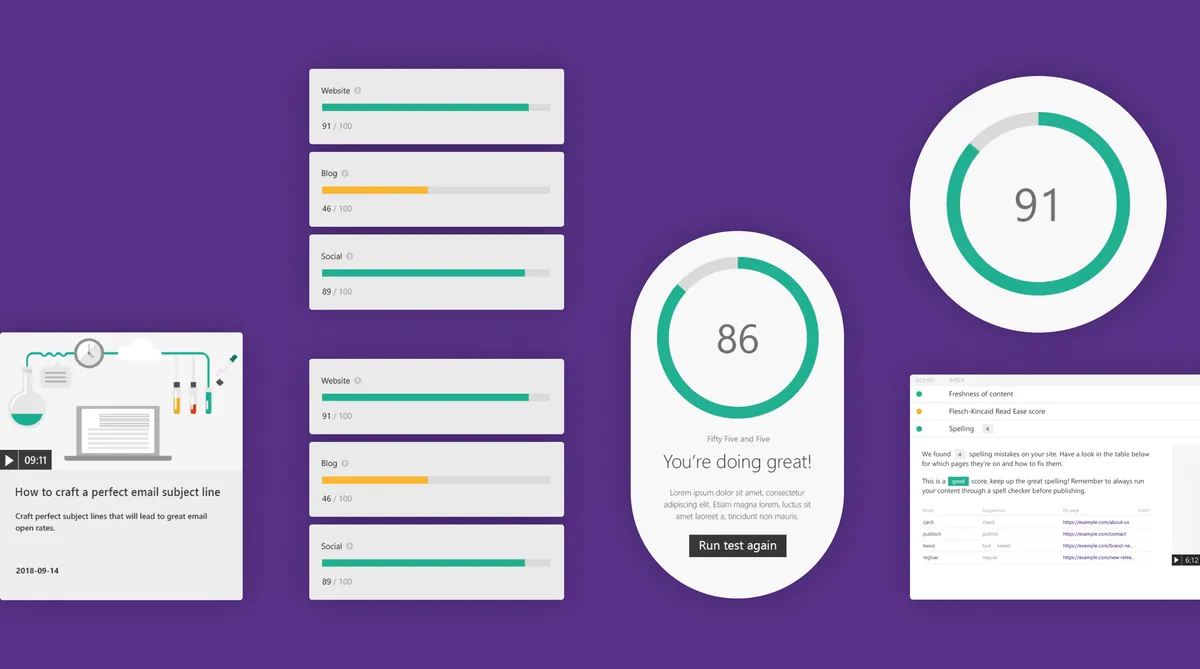
A web platform that reads partners’ marketing and scores it. We called it the Partner Benchmarking Tool, and the project ran for eight months.
It ran more than 40 tests across all kinds of content, from spelling and tone to SEO signals and bugs in page code. It covered thousands of companies across tens of thousands of channels, websites, blogs and social accounts, using machine learning and AI to score them as it went. Microsoft teams in the UK, the US and Canada piloted it.
It was built to answer one question: did giving marketing funds to this company get a better result for Microsoft?
Jennifer Tomlinson, Global Channel Marketing Leader at Microsoft, said this about it:
Fifty Five and Five have developed an AI marketing platform that totally changes the game when it comes to understanding our financial investment in partners.
Jennifer Tomlinson Global Channel Marketing Leader, Microsoft
It was also the proof, for us, that we could build software. Compass, our AI marketing platform, came after it.
Want to see what your partner funding produced?
We build AI tools for partner marketing teams, starting with the question you can't answer yet.
Talk to usWhat should a vendor check in a partner’s marketing?
Four things, and software can check all of them on a partner’s public marketing without asking the partner for anything. They’re the groups our tests fell into.
- Is it written for its audience? How complicated the language is and the terms it uses. Long sentences and vendor jargon lose a buyer who isn’t a specialist.
- Does the tone fit the buyer? A partner selling to finance directors needs to sound like it understands them.
- Can buyers find it? SEO signals. A campaign page nobody can find in search won’t do much, however good it is.
- Does it work? Technical errors and broken code. If a funded campaign points at a page that doesn’t load, the money’s gone.
There’s a fifth I’d want a person to look at, because it’s a judgement call. Is the marketing the partner’s own, or the vendor’s messaging copied word for word? Copied messaging is safe, and it gives a buyer nothing to choose that partner over the next one.
These checks don’t measure pipeline. They show whether the money produced marketing a buyer could use, which is what MDF is meant to pay for.
How do you turn partner scores into funding decisions?
The useful number is a comparison. One score shows how good a partner’s marketing is. To see whether the funding helped, compare funded partners with ones you didn’t fund, and each partner with its own work before the money arrived.
That’s what Microsoft wanted to know. A partner whose scores rise after funding, while similar unfunded partners stay flat, is probably using the money well. A partner whose scores don’t move probably spent it on something that ran once.
- Back the partners who improve. They’re using the money well so far.
- Help the ones who don’t. A low score may just mean a small partner with no marketing person, and that calls for help with content and training.
- Show partners their scores. If I were running a programme, I’d share them. A partner who can see their broken pages can fix them.
How do you measure the ROI of MDF funds?
To measure the return on MDF funds, measure the marketing the funds paid for as well as the claims. Score each funded partner’s public marketing for whether it’s readable, fits the buyer, can be found in search and works technically. Score a group of partners you didn’t fund in the same way, and keep each partner’s scores from before the funding. Then compare. If funded partners improve and similar unfunded ones don’t, that’s a good sign the money is buying better marketing. It isn’t proof of revenue, so add whatever deal data partners will share, such as registered opportunities or co-sell wins. Repeat it every funding cycle, so you can see which partners keep improving and which spend the money on one-off activity. Across thousands of partners, the scoring has to be automated.
What would we add if we built it again now?
I’d add AI search. When we built the tool, the question was whether a buyer could find a partner on Google. Now some buyers ask ChatGPT or Claude which partner to use, and get a shortlist back. A partner the assistants never name won’t make that shortlist.
We tried it on ourselves last week. We asked ChatGPT and Claude 18 questions our own buyers ask, twice each, and we were named in 10 of the 72 answers. Lower than I’d hoped. I’d want the same check on every funded partner: when a buyer asks an AI assistant for a Microsoft partner in their industry, does this one come up?
I suspect a first version would also be quicker to build now. A lot of the reading and scoring is work today’s models do well.
Enjoying this article?
Get more B2B marketing insights delivered straight to your inbox.
Thanks for subscribing!
So how can a vendor tell what its MDF funds produced?
Score the marketing the funds paid for, as well as the claims. Check what each funded partner published for readability, tone, findability and whether it works. Then compare funded partners with unfunded ones and with their own work before the money, and check it against deal data where you can get it.
We did that for Microsoft, across more than 10,000 partners and $10m of MDF funds. If you fund partners and you’re guessing what it bought, I’m happy to show you how it worked.