What does an AI-powered marketing agency actually do differently?
A true AI agency not only uses AI in how it works (and I mean reimagining things with its own tools) but also uses the best of AI to power its clients' work. So for TCS and the London Marathon we delivered a digital experience that would have been impossible to conceive just 12 months ago.
This is not about ChatGPT
I should probably start with what most people expect when they hear “AI-powered marketing agency.” They expect an agency that uses ChatGPT to write blog posts faster. Maybe some automated reporting. A chatbot on the website. The same services, just quicker.
Sales and marketing people at big enterprises, and some smaller companies too, come to us with a problem at a specific stage of their revenue cycle, and we build something to fix it. Bespoke AI tools, systems, and processes, built on their data. Sometimes that’s a one-off project where the client owns the IP. Sometimes it’s a licensed tool. Sometimes it’s a retainer, but even then, there’s an AI-powered way of delivering it that didn’t exist two years ago.
We might use and deploy existing tools, but typically we are building custom user interfaces and apps for very specific problems, using the latest foundation models from OpenAI and Anthropic (plus some open source).
That is what Fifty Five and Five is now. It’s taken us a bit longer than I’d hoped, but we’re finally here. I’m writing this from our office at the Leather Market on Weston Street, just south of London Bridge. There are fifteen of us now. We used to be a lot bigger. We hit nearly thirty just before COVID (before COVID, anyone remember that?) and I thought we’d go north of that. But looking back, headcount was/is a vanity metric. It’s what you do with a team. We had some great people over the years. Turns out we had a few not so great ones too. People who didn’t get who we were then certainly wouldn’t get who we are now. I probably lost control a bit. But now we’re fifteen, hiring a number of roles, with a strong freelance community we’ve worked with for years and big ambitions. Much tighter and focused. Developers, designers, and strategists, all of them systems thinkers. Smart people, open to the future. No account executives (we might go back to that). No copywriters sitting in Word all day. A very different team, and a very different company to the one I started in a basement in 2014.

That journey from thirty people back to seven and then forward again, what it taught me, is part of why I don’t buy what most agencies are selling right now. Most of them slapped “AI-powered” on their website and kept doing the same thing. We rebuilt everything: the offering, the team, the tools, yes the website. 92% of businesses plan to invest in generative AI within three years, but only 1% believe their investments have reached maturity (McKinsey ). I think that gap exists because most companies are bolting AI onto old ways of working. We went the other way. We tore it up and started again. If you’re trying to choose the right AI marketing agency , that’s the first distinction to make: who actually rebuilt their model around AI, and who just added it as a feature.
How we got here
I’ll be honest. This transformation was hard. Really hard, if I’m being really honest. There were points where I wasn’t sure if the business would survive the shift, or if I would. I built Fifty Five and Five from nothing, but rebuilding it was way tougher.
We picked up a major new client in SAP late last year. Awesome, we love that. We just built and launched our new website. We finally have a story and a message that explains what we really offer in 2026, with case studies to prove it and the odd award to go with it. From the outside, it probably looks like things fell into place.
They didn’t.
There was a lot of internal debate. Long conversations about what we were becoming, whether it would work, whether clients would pay for tools instead of retainers. I have this pattern that my wife Katie would recognise instantly: I plan to leave work at six, run home, be back for dinner with Georgia and Thomas by seven. Then something comes up. A client call. A project that’s nearly there. An idea I can’t let go of, and I generate about a hundred of those a day. I tell myself I’ll cycle instead of run, buy myself an extra half hour. Then time runs away and I’m walking through the door at half eight, apologising. Not super healthy, and I’m working on it. But sometimes throwing hours and effort at something is the only way through. I carry a lot: the business, the team, the clients, the product ideas, the family stuff. Every founder does. The trick is not pretending it’s easy.
I founded Fifty Five and Five in 2014 from a basement with not much of a plan. The early work was writing blog posts on retainer for Microsoft Partners. Starting price: £75, unlimited edits. I was a frustrated writer who got a fair bit published as a freelancer myself - articles for CMSWire on SharePoint, a few magazine columns, once even in the Guardian. Then I got freelancers to help me. Then boom, Fifty Five and Five. We quickly became, and stayed, a full-service agency. We did a bit of everything: content, campaigns, paid media, social. That meant some cool projects, but also running LinkedIn campaigns for five grand that nobody wanted to do.
Fast forward to 2024. By then we’d been working with Microsoft since day one, TCS for years, Google for tonnes of projects. We’d built the Partner Benchmarking Tool for Microsoft Corp, a proper SaaS product that evaluated 10,000+ partners globally. That was the first proof point that we could build technology, not just provide services. But we hadn’t yet made the full shift.
In June 2024, I sent a newsletter called “The Marketing Agency is Dead.” Three phases: using AI tools now, deploying agents next, something unrecognisable after that. It was bold. It was provocative. And looking back, it was about six months ahead of where we actually were. Clients didn’t respond to it the way I’d hoped. Most of them just wanted their next campaign delivered. The gap between what I was saying publicly and what was actually happening internally was real, and it was uncomfortable. I was selling a vision of the future while still delivering the present.
What actually moved us forward was much quieter:
- We stopped evangelising and just started using AI in our everyday work
- Building small tools to speed things up
- Automating the tedious bits
- I produced 74 AI-generated videos in one experiment using Veo3, not to debate what AI could do but to find out
- That’s how I think: run the experiment, skip the committee
- The tools got better. The clients started asking for them. And gradually, the thing we were building on the side became the thing.
Why the traditional agency model stopped working
Every enterprise client we work with has a version of the same conversation. They come to us with a problem: leads aren’t converting, their CRM is a mess, content isn’t driving pipeline, they can’t tell who’s in-market. The agency model says: here’s the problem, we’ll do the work, send us a brief next month. Repeat.
But the problems aren’t one-offs. They’re systemic. The same pain points show up at every stage of the funnel, across every client. And doing the work on repeat doesn’t fix the underlying issue. It just manages it. I had a call last month with a head of marketing at a mid-market cybersecurity company. Sixty people, decent product, growing fast. They were spending £15k a month on paid campaigns and couldn’t tell me which leads had actually converted to pipeline. Their CRM had three different lead statuses that meant the same thing, and marketing and sales were blaming each other for the same gap. I’ve had that exact conversation, with minor variations, probably fifty times in the last three years. The symptoms vary. The root cause is almost always the same.
The shift for us was realising that instead of doing the work, we should build something that fixes the problem permanently. Build a tool on the client’s data that solves their specific issue at their specific funnel stage. Then give it to them.
That last bit was hard for some of the team to get their heads around. Why are we building a tool to optimise content for AI search when we could just do it on retainer? Because that’s what we do now. We build the fix, not rent the labour.
Ok, time to be searingly honest about something (searingly?!). But I wanted to build things. I’m sort of an accidental marketing person. In fact, I’m not a marketing person. I sometimes wonder how I ended up running a marketing agency. I studied Computer Science. When I was about sixteen I built an entire online game called Graal, based on the SNES game The Legend of Zelda. I ran emulation websites, got paid in USD paper cheques for advertising. I built websites for my parents’ friends. That instinct to build systems, to reduce a problem to a workflow that a machine can run, has never gone away. Running a services business can feel restrictive when your brain works that way. So the shift from agency services to building AI tools wasn’t really a pivot. It was me finally doing what I should have been doing all along.
The other thing I notice constantly is how many people still think AI means ChatGPT. Open a browser, type a prompt, get an answer. That’s it. But AI is so much more than that. It’s not just a tool, it’s a way of thinking about work. The real opportunity isn’t to automate what you already do. It’s to reimagine it entirely. What would this process look like if we designed it from scratch with AI at the centre? Not “how do we make this faster” but “what if we removed the manual steps altogether?” That’s the question most companies aren’t asking. And it’s the question that changed everything for us.
This website is the proof
The site you’re reading this on is a good example. We didn’t buy a template or spin up a big heavy CMS. We built it from scratch on Hugo, an open-source static site framework, and hand-coded every page. We focused on copy and message. Under the hood it is lean. It scores 100/100 on Google PageSpeed. It’s SEO-optimised. It’s structured for AI search engines so that when someone asks an LLM about B2B marketing agencies, our content surfaces. And we don’t edit it through a traditional CMS. We use Claude Code. We talk to the website and it edits itself.
That probably sounds unusual. It is. Most agencies use Webflow or WordPress because it’s easier. And for lots of clients they are the right tool. But easier isn’t the point, and we want to test the latest thinking on ourselves before we bring things to clients. The point is: what does a website look like if you design it from scratch with message, AI and performance as first principles? It looks like this. A 100/100 PageSpeed score, sub-second load times, semantic HTML that AI models can actually parse, and a conversational editing workflow that lets us publish and iterate faster than any drag-and-drop builder.
It’s not just our website. It’s a manifestation of the offering. If we can build this for ourselves, imagine what we can build on your data, for your problem, at your specific stage of the funnel.
We build AI tools that fix specific sales and marketing problems
I thought hard about how to talk about what we do. Because truthfully, we can build a tool to do almost anything. Especially with AI. I personally have about a hundred ideas an hour and tend to start building half of them before lunch. I don’t officially have ADHD. But there’s probably something going on there. My brain doesn’t do incremental improvement. It jumps straight to: what if we automated the entire thing?
So we had to focus. And the way we focused was by thinking about the full revenue cycle, end to end: from first awareness through to expanding accounts. Every B2B company has the same fundamental stages, and every stage has its own set of problems.
Awareness: You’re targeting everyone and converting no one. Your messaging doesn’t land. Nobody knows who you are.
Demand gen: Your CRM is a mess, so everything downstream breaks. You’re getting leads but they don’t convert. You can’t tell who’s in-market until it’s too late.
Nurture and activation: Your ABM is random acts of marketing. Personalisation takes too long to do manually. Leads go cold between first touch and sales.
Sales execution and expansion: Speed-to-lead is slow. Qualification is based on gut feel. You don’t know which customers are ready to expand.
We’ve seen problems at all of these stages. Across Microsoft, TCS, SAP, Google, and hundreds of smaller companies over 11 years. That’s 3,200+ tracked opportunities. That kind of pattern recognition matters, because it means when a client comes to us with a problem, we’ve probably seen it before. We know where in the funnel it sits, what’s causing it, and what kind of tool will fix it. I’m not interested in reinventing the wheel. I want battle-tested approaches applied to specific problems with the right technology. That’s what 11 years of this work gives you.
The delivery model is whatever works. One-off project where you own the IP. Licensed tool. Retainer. The point isn’t how you pay for it, it’s that you’re getting a purpose-built solution, not a team of people doing manual work on repeat.
79% of companies now report adopting AI agents, and two-thirds confirm they’re delivering value (PwC ). But the ones getting real results aren’t the ones who bought an off-the-shelf tool and hoped for the best. They’re the ones who built something specific to their problem. We wrote about the potential impact of marketing AI agents when the shift first started — the reality has exceeded those early predictions.
Why generic AI tools don’t work for B2B teams
I have a way of explaining this that I keep coming back to. Most agencies use AI in HOW they work. Faster content. Automated reports. Quicker turnaround. The work is the same, it just gets done more efficiently.
We use AI in WHAT we deliver. The tools we build for clients are the product. Not a faster version of the old product. A fundamentally different one.
Generic tools like ChatGPT, Copilot, or Jasper are brilliant at what they do. But they produce generic output. They don’t know your brand. They don’t understand your industry. They have no idea where in your funnel things are breaking. They can’t tell the difference between a demand gen problem and a nurture problem. And that distinction matters, because the fix is completely different.
Only 47% of marketers feel confident integrating AI strategically (HubSpot ). And 80% of AI project failures trace back to data quality issues (Gartner ). Both stats point to the same problem: teams are using generic tools on messy data and wondering why the output isn’t useful.
Got a problem in your funnel?
We build AI tools on your data to fix specific sales and marketing problems. No generic solutions.
Let's talkWhat “bespoke” means in practice is this - Trained on your brand voice, your customer data, your industry context, your specific funnel-stage problems. Built with your unique problems in mind, a totally custom made solution.
The economics have shifted too. With AI-powered coding, and I’m a big fan of it in all its forms, bespoke no longer means costs the earth. Two years ago, building a custom tool for a client was a six-figure conversation. Now we can prototype in days and ship in weeks. I believe we’re heading towards a world where every team, maybe even every project, has its own purpose-built tools. Not a single SaaS platform that tries to do everything for everyone, but something small, specific, and built on your data for your problem. That changes what software looks like entirely. But that’s a topic for another day.
What it looks like when AI-powered marketing actually works
I could list case studies with bullet points. But I’d rather tell you what it actually felt like to build one of these things.
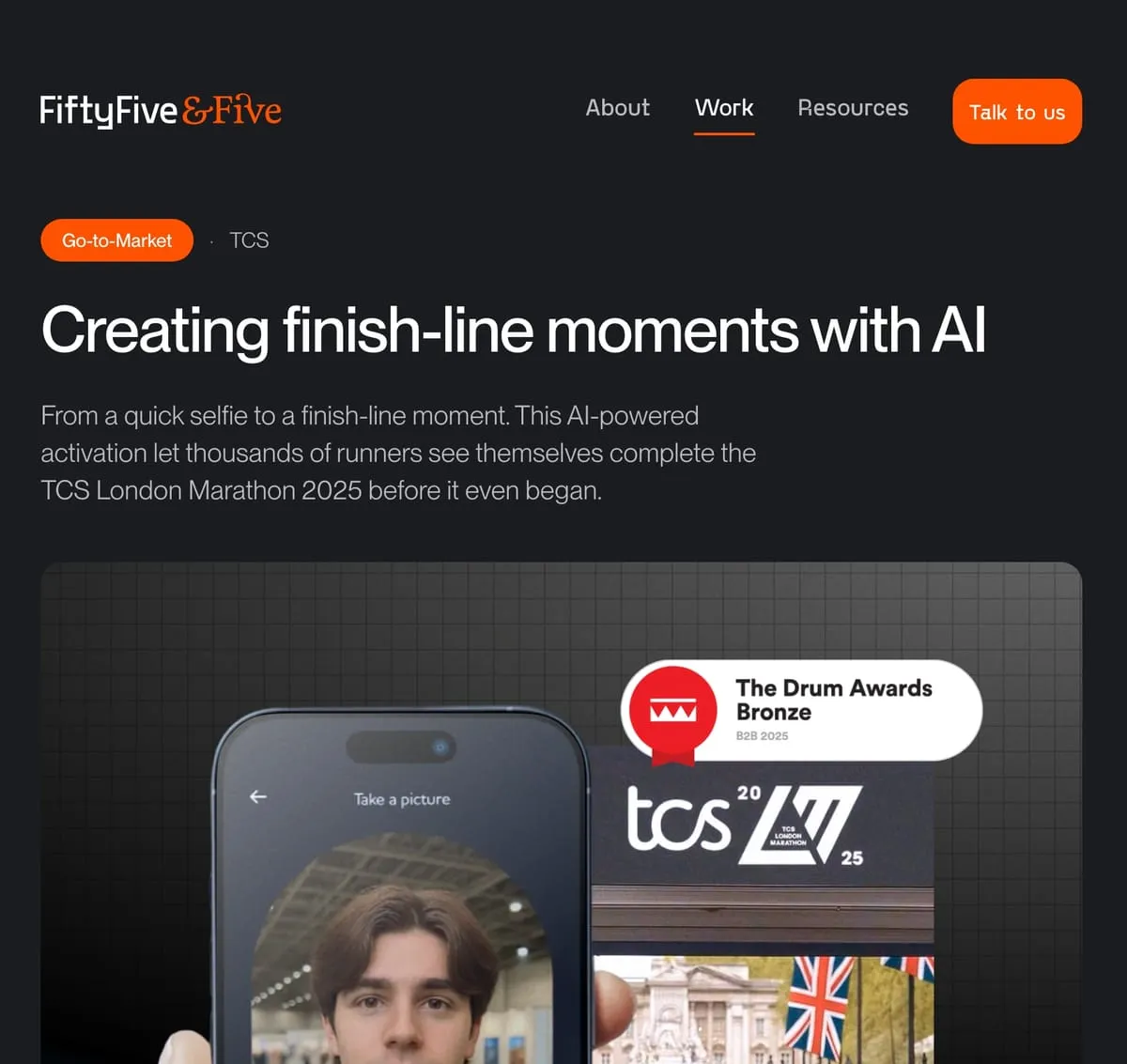
In April 2025, TCS asked us to build something for the London Marathon. They’d been title sponsor for seven years. They wanted an activation that would let visitors see themselves cross the finish line before the race had even started. The concept: take a photo of someone, generate a 3D avatar that looks like them, place it in a photo-realistic finish-line video, and deliver it to their phone. At scale. In three days. At an outdoor expo with patchy Wi-Fi.
We had about a month to build it.
Fergus Hannant, our Senior Designer, built the entire app in Riff.ai (formerly Databutton). He started in Figma, then moved to building in real time, designing and shipping simultaneously. The app used AI to analyse each person’s photo and suggest appearance settings for the 3D model: body type, skin tone, hairstyle. The data then passed to an avatar platform via API, generated the model, composited it into pre-rendered race scenes, and delivered a personalised video by email. Nine different AI tools in the pipeline, 40,000 machines rendering in parallel.
We wanted it to be inclusive. So we built prosthetic limb options into the 3D models. Kids. A wheelchair option. We spent days thinking through every combination of body type and appearance, making sure nobody was left out. And then, about a week before launch, someone asked: “What about beards?” We’d thought about prosthetics, about wheelchair users, about children. We’d agonised over skin tones and hairstyles. And we’d completely missed facial hair. The most basic thing. That is what building new technology is actually like. You think you’ve covered everything, and then the most obvious human detail blindsides you.
Barnaby Ellis, our Head of Strategy, was the link between the client, the experiential agency, and our team from the first kick-off call through to the on-site setup. He was first on site the morning of the expo. Given all the new tech and ideas we’d crammed in, as Barnaby put it, “it was touch and go at times.” We discovered a handful of last-minute bugs that only showed up in the live environment. I was on the tube heading down to help him, laptop open, pushing fixes to production somewhere between Borough and Canning Town. Not glamorous. But that’s what building things looks like when the deadline is a hundred thousand people arriving at the ExCeL Centre.
It worked.
Fergus said seeing thousands of runners use the tool across the expo was a highlight he won’t forget. Barnaby said they “delivered in style.”
What Fifty Five and Five built in the time they had was amazing. 1,500 runners had a photo-realistic AI video created in near real time.
Anmol Patel TCS
That’s one project. But it shows you the pattern: a client has a problem or a challenge, we come up with an awesome idea to push the boundaries, we build something, and we do it fast because AI makes that possible now.
There are more examples of our work here - AI-powered content platforms, data enrichment tools, interactive microsites, AI search strategies. Each one started with a specific problem at a specific stage of the funnel. We’ve also documented how businesses achieve ROI with custom AI tools across different use cases.
Enjoying this article?
Get more B2B marketing insights delivered straight to your inbox.
Thanks for subscribing!
What does an AI-powered marketing agency do differently?
It’s not what most people expect. It’s two things at once.
The first is how we work. I’ll freely admit we’re addicted to Claude Code at this point. We run AI agents overnight that process research and analysis while we sleep. People on the team work in terminals now, orchestrating multiple agents at once, leaving tasks running and picking up results in the morning. We codify every author’s voice and identity into portable files so AI output sounds like them, not like a chatbot. We can do deeper, more thorough competitive research in an afternoon than we used to manage in a week. A proposal that took three days to pull together now starts with an hour of AI-powered analysis that surfaces patterns across every previous engagement. AI has changed the way this team operates in ways that are hard to explain until you’ve lived it.
But that’s the less important bit. The far bigger shift is what we deliver.
We build tools on client data to fix specific problems in the sales and marketing funnel. Not campaigns. Not content calendars. Tools. Every problem has a fix. Usually it’s not that complicated. You just need someone who understands the funnel well enough to diagnose where it’s breaking, and someone who can build the technology to fix it. We happen to be both. Eleven years of B2B marketing and a team of fifteen systems thinkers with a founder who studied Computer Science and still can’t stop building things.
If you’ve got a specific problem in your sales or marketing funnel, whether it’s awareness, demand gen, nurture, or expansion, let’s talk about building something to fix it .
Hard work and luck. That’s how we got here. And we’re just getting started.