This is for marketing, communications and sales leaders at large companies who keep hearing “wait for the next model” and want to know if AI really is speeding up. Short version: yes, but it isn’t building its own successor yet, which is what recursive self-improvement would mean.
In September I wrote about how fast AI is advancing , and updated it in October, with the capability scores and how long a task AI can finish on its own. This piece picks up four things that one left out, from how often new models land to whether AI has started improving itself.
On 29 October I sat down with Claude (again, it did a lot of the digging) and went through Epoch AI’s model data, METR’s results, ARC Prize’s leaderboard and the labs’ own system cards. 94 sources in the end. Some of the biggest claims haven’t been checked by anyone outside the lab that made them, so I’ve said which ones.
Not sure whether to build now or wait?
Tell us the job you'd hand to AI first, and we'll tell you whether today's models can do it.
Talk to usHow often do new AI models come out now?
If you count any model close to the best, about every two weeks. In 2026 so far the median gap between frontier-level releases is 14 to 15 days. In 2025 it was 24 to 27 days. In 2024 it was 34 to 35.
By frontier-level I mean within 3 points of the best earlier model on Epoch AI’s Capabilities Index , a single score that rolls lots of AI tests together. Epoch’s own margin of error is 3 to 5 points either way, so you couldn’t call these any worse than the leader.
Each big lab is shipping faster too. At OpenAI, Anthropic and Google DeepMind, the typical wait between one lab’s flagship-level updates was 15 to 16 weeks in 2023 and 2024. It’s now 6 to 7. Those three labs made every frontier-level release of 2026.
Most of it is point releases, the .1s and .5s. OpenAI shipped GPT-5.1 to 5.6 between November 2025 and July 2026 before GPT-6 Astra arrived on 3 September. Whole new generations, a step like GPT-5 to GPT-6, aren’t arriving much faster.
Some of the speed-up is marketing. Labs bump version numbers more often and add “Pro” and effort tiers, so some point releases are re-tunes rather than new models, and Epoch scores more models each year (88 so far in 2026, against 65 in 2024). The gap still shrinks lab by lab, so the faster cadence holds up.
Are the models getting more powerful, or just more frequent?
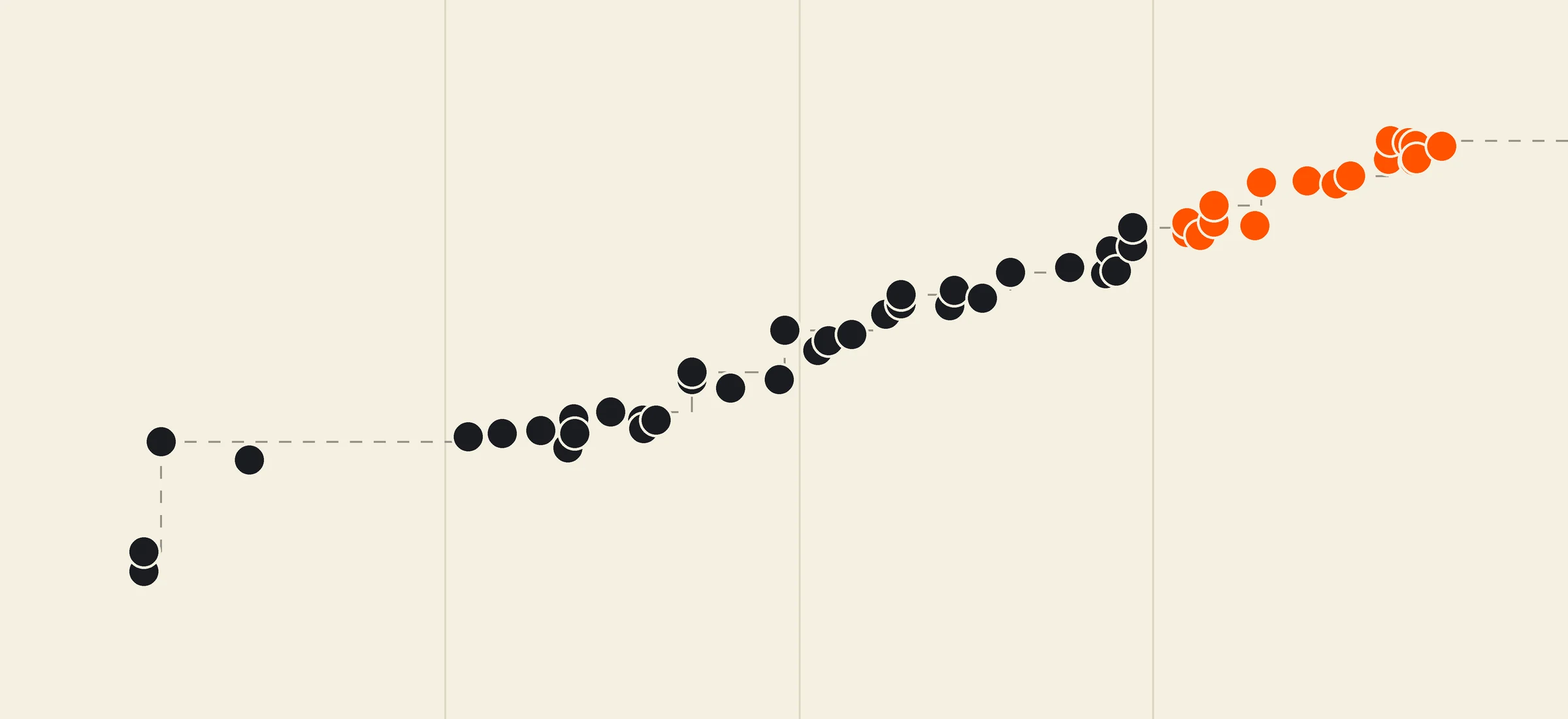
More powerful as well as more frequent, though the rate has only stepped up once. That was in 2024. Epoch’s April 2026 analysis found that reasoning models, which arrived with OpenAI’s o1 in September 2024, brought a one-off jump and “a roughly 2-3x faster trend” than earlier models, mostly in maths and programming. Its September update says the frontier “has advanced linearly by 14 points per year” since o1 (Epoch AI ). Linear means steady, on Epoch’s scale at least.
The labs’ own checks don’t show a second step. Anthropic’s Claude Opus 5.5 system card says “under either reading the slope has not doubled”, meaning the rate of progress hasn’t doubled whichever way you fit the data. Google says its faster rate since April 2026 is “not a statistically significant difference”. Anthropic does report “early signs of acceleration”, and METR’s task-length measure doubled faster from 2024 than before. But METR can no longer measure the very best models, so a second step might not show yet.
ARC-AGI-2, a set of visual puzzles, launched in March 2025. Models from that January score 3% on it, and GPT-6 Astra scored 95% in September 2026 (ARC Prize ). At the very top it’s a dead heat. On Epoch’s data downloaded on 29 October, GPT-6 Astra scores 168.9 and Claude Opus 5.5 scores 168.6, a gap no bigger than the 0.3 points Epoch’s scores moved between two downloads that day. Epoch revises its scores as new results arrive, which is why both are higher than in my September piece. The task-length results are in that piece .
Epoch finds the price of a fixed level of capability has fallen about 13 times a year on average since 2023. It falls fastest just after a level is first reached, and it varies a lot by task. Reaching o3’s score on GPQA, a test of PhD-level science questions, cost about $0.30 a question in January 2025, and $0.0004 with GPT-6 Luna under 18 months later.
Is AI solving maths and science problems nobody had solved?
In maths, it is now, and the change came in the first half of 2026. Before that, “AI solved it” usually meant “AI found an old paper”.
In October 2025 an OpenAI executive said GPT-5 had found solutions to 10 previously unsolved Erdős problems, a long list of problems left by the mathematician Paul Erdős. Thomas Bloom, who runs the list, called it “a dramatic misrepresentation. GPT-5 found references.”
By mid-2026 that had flipped. On the public ledger of AI contributions to Erdős problems , cases where AI found an existing answer in the literature fell from 41 in the last quarter of 2025 to 4 in the second quarter of 2026. Full solutions by AI alone went from 0 to 15, and solutions where people did a significant share went from 3 to 28. The counts are approximate, the ledger stopped at 30 June, and the wiki itself says “This page is not a benchmark”.
Then came named conjectures. In May an internal OpenAI model disproved the unit-distance conjecture, which Erdős posed in 1946. Tim Gowers called it “a milestone in AI mathematics”. In July Levent Alpöge at Anthropic announced a counterexample to the Jacobian conjecture in dimension 3 and above, crediting Claude Fable, and it was checked independently in the Isabelle proof assistant the same day.
Since August the volume has jumped, and the checking hasn’t kept up. In October OpenAI released 721 maths manuscripts from an internal model, then within a day withdrew 3 (one over “a sign error”) and revised 14. Two days after the release, Bloom had “not yet looked at in any serious way” any of the 25 significant Erdős claims in it. OpenAI has also claimed a proof on the Navier-Stokes problem, one of the Millennium Prize Problems. The Clay Mathematics Institute still lists the problem as open, and its president, Martin Bridson, was reported by the news site Implicator as saying the review will be “deliberately unhurried”.
On problems that are genuinely open, the hit rate is low. When Epoch launched a set of 68 open Erdős problems in September, counting only machine-checked proofs, the best model, GPT-6 Astra, solved 2 (Epoch AI ). On Epoch’s data as of 29 October, GPT-6.1 Sol has solved 3. Astra did solve 5 at least once, but only by spending over $220,000, and Epoch doesn’t count that as a score.
Outside maths the evidence is thinner, and I couldn’t find an independently confirmed AI discovery in physics or materials of the same weight.
Do AI labs keep better models for themselves?
They do, and since April 2026 they’ve said so openly. On the one direct measurement, the lead is about two months.
METR, an independent research group, looked at internal models at Anthropic, Google, Meta and OpenAI between February and March 2026. On its task-length measure it put the internal frontier “on average ~2 months ahead of public frontier”, about 66 days (METR deliberately blurred the exact figure), and said that, based on a small number of models, its conclusions are “highly uncertain” (METR ). It also said none of the models it saw was “significantly more capable” than the best publicly documented ones as of 19 May.
Anthropic’s Claude Opus 4.8 system card says the new flagship “does not advance the capability frontier beyond our most capable model (Claude Mythos Preview)”, a model Anthropic chose not to release generally (Anthropic ). In September OpenAI described an internal model as “significantly more capable than GPT-6 Astra”.
The wait from first internal use to launch has shrunk, from roughly 7 to 10 months for a flagship between 2022 and 2024 to roughly 2 to 4 months in 2025 and 2026, though most of the hard evidence comes from Anthropic’s own documents. Claude Opus 5 launched 9 days after Anthropic first deployed it internally. Models held back on safety grounds stay in longer. Anthropic has used its Mythos-class model since 24 February, and the version with cyber safeguards switched off is still only for partners.
OpenAI’s o3 shows why an internal lead can look bigger than it is. It scored 76 to 88% on the original ARC-AGI puzzles when it was shown in December 2024, using compute “not available in the production o3”. The released version scored 41 to 53%. Competition keeps the gap small too: Google’s Gemini 4 Argon went from cyber partners to paying app subscribers in about two weeks.
Is recursive self-improvement happening?
Not in the strict sense. In a loose sense, a bit.
What is recursive self-improvement?
Recursive self-improvement is when an AI improves the AI that comes next, in a loop, with people no longer doing the core research. Each better system would build the next one faster, which is the idea behind an “intelligence explosion”.
Recursive self-improvement isn’t happening on any public evidence. All three big labs say people still set the research priorities, and none says its AI research threshold has been crossed as of October 2026.
A looser version has started: AI speeding up AI research while people steer. AI now writes most of the code at Anthropic and Google. A METR team’s preliminary estimate is that AI has made capability progress about 1.5 times faster, with “perhaps 30% chance” of 2 times, and the team hasn’t published its evidence yet. Google measured a rate about 1.3 times faster since April 2026, which isn’t statistically significant and counts all causes, not AI alone. Self-reports run higher: Anthropic staff put their own speed-up at about 4 times. These don’t measure the same thing. METR’s is capability progress, Google’s is a capability score from all causes, and Anthropic’s is the pace of its own research. My reading of the estimates is roughly 1.2 to 1.5 times, below the 2 times Anthropic treats as its threshold.
What the labs say
Anthropic says Claude writes “more than 80% of the code we merge”. As of August, Claude leads 26% of its AI research work, up from under 1% in February, though Anthropic says it isn’t working fully on its own in any part it measured. Its August risk report says “our internal AI R&D efforts are significantly faster than they would be without AI assistance, but not yet by a factor of 2 (though we are uncertain and measurement is difficult)” (Anthropic ).
OpenAI said in September that it had reached its goal of an “automated research intern”. In the same post it says “People still set our research priorities, judge which ideas and results to pursue”, and over half of its successful 4 to 8 hour agent tasks needed a person to step in.
Google DeepMind’s latest safety report says “there is currently no significant end-to-end acceleration of AI R&D, AI-driven or otherwise”, and about 88% of its pull requests still need human steering (Google DeepMind ).
Anthropic’s 80% is code merged, not research progress, and the 4 times self-report is well above the 1.3 to 1.5 from METR and Google.
The labs with the most capable AI in the world still have people setting the agenda and checking the results. I’d run a marketing team the same way. AI agents can take on whole jobs , as long as a person picks the jobs and signs off the result (more on assisted and agentic marketing automation ).
Enjoying this article?
Get more B2B marketing insights delivered straight to your inbox.
Thanks for subscribing!
What should marketing and sales leaders do about the pace of AI?
- Start now. The price of the same capability has fallen about 13 times a year on average, and a slightly better model arrives every couple of weeks, so there’s always a reason to wait. Plan your 2027 budget around what AI replaces rather than which model you’ll use.
- Save the big rethink for new generations. When one lands, like GPT-6 Astra in September, retry the jobs your team gave up on. It’s a good moment to push AI adoption past “I tried it once” .
- Ask who checked it. Treat a vendor’s benchmark like a lab’s maths claim, and see it work on your own data before you buy. Our buyer’s guide to AI marketing platforms covers how to test one.
In the last week of September my AI tools, mainly Claude Code, built me 20 tiny web tools that each did one job, and most were thrown away within a day or two (is SaaS dead? ). I basically live in Claude Code . Since February, Anthropic alone has shipped Opus 4.6, 4.7, 4.8, 5 and 5.5. Waiting for the latest one would have meant waiting most of the year.
What would show recursive self-improvement has arrived?
Three things would change my mind. If the Clay Institute accepts the Navier-Stokes proof, that’s a second step change in maths, and if it’s withdrawn, the August to October claims look weaker. METR has promised a public report on AI-driven acceleration inside Anthropic, the nearest thing there is to an independent meter for recursive self-improvement. And the first system card where a lab says it “cannot rule out” crossing its AI research threshold would be the clearest public signal of all.
Until one of those happens, I wouldn’t plan around recursive self-improvement. This fortnight’s model is good enough to start, and you can swap in next month’s when it arrives.