This is for whoever does marketing at a Microsoft partner or MSP. Be known for one thing, for one kind of customer, and prove it with customers a buyer recognises. Let Microsoft’s badges, directory and campaigns carry your message further.
Cover the logo on most Microsoft partner websites and you’d struggle to tell them apart. Microsoft 365, Azure, security, “trusted advisor”, “digital transformation”. A lot of MSP marketing reads the same way, because everyone resells the same Microsoft products and starts from the same Microsoft messaging.
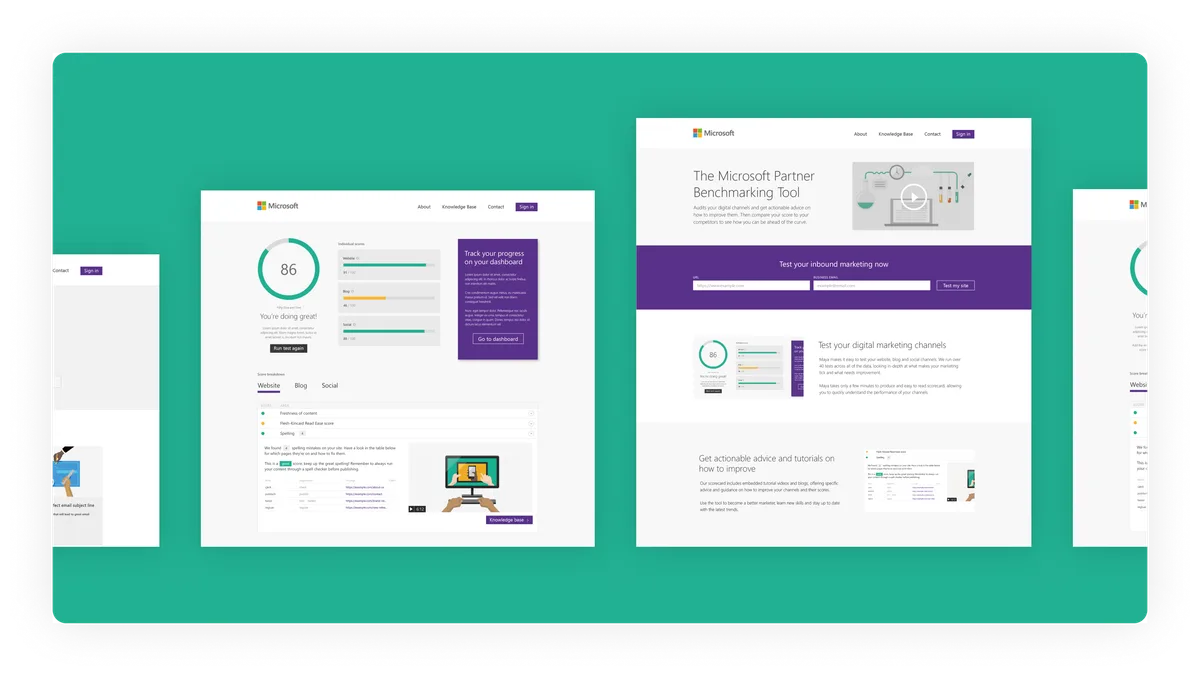
I’ve read a lot of Microsoft partner marketing . I worked for Microsoft partners before I started Fifty Five and Five. Years ago we ranked the UK’s Microsoft partners on their marketing. And we built Microsoft the Partner Benchmarking Tool, which covered more than 10,000 partners and ran more than 40 tests on their marketing, across websites, blogs and social accounts (case study ).
What should a Microsoft partner’s marketing say?
What you’re best at, who it’s for, and how a buyer can tell. Someone looking for a partner wants to see that you’ve solved their problem before, for a company like theirs, and that it worked.
So you have to choose. “We move manufacturers’ file servers to Microsoft 365 without stopping the production line” gives a buyer something to recognise. “End-to-end Microsoft solutions” doesn’t. Most partners do more than one thing, which is fine. Lead with the one you’re best at and give each of the others its own page.
Microsoft’s advice on partner profiles is along similar lines. Its guidance for the business profile partners publish in Microsoft Marketplace says to “Focus on your company’s specific experiences with Microsoft offerings” and to “Communicate in plain, everyday language”, describing what you offer “in terms of what they do, the business needs they address, or the tasks and objectives they help customers achieve”. On the tags that make a profile findable, it says to “prioritize quality over quantity” (Microsoft Learn ).
Then prove it. A named customer, what you did for them, and a number. A row of customer logos only tells a buyer who you’ve worked with.
How is MSP marketing different?
An MSP is asking a buyer to trust it with their systems for years, so the marketing has to show what being looked after by you is like, as well as what you can set up. Who picks up the phone and how quickly things get fixed are the questions I’d want answered on the page.
What is MSP marketing?
MSP marketing is how a managed service provider wins and keeps customers for ongoing IT services, such as running a company’s Microsoft 365, devices, security and support for a monthly fee. It’s different from marketing a one-off project, because the buyer is choosing who will look after their systems for years rather than who will finish one job. Good MSP marketing shows what that looks like day to day: who the customer will deal with, how quickly problems get fixed, which industries and company sizes the MSP knows, and how long its customers stay. It also has to be specific. Most MSPs resell many of the same products, so the products rarely set one apart. A clear specialism, named customer stories and proof a buyer can check, such as Microsoft designations, do much more. MSPs in Microsoft’s partner programme can also use its badges and a profile in the Microsoft Marketplace partner directory.
Which Microsoft partner benefits help you market yourself?
Five of them matter for marketing, in the order I’d sort them out.
- Solutions Partner designations and specialisations. These are proof Microsoft has checked. A designation rests on a partner capability score built from performance, skilling and customer success, and Microsoft says the scoring “Ensures that customers who are searching for partners can trust Solution partner designations” (Microsoft Learn ). Specialisations go a level deeper, and Microsoft says they help “customers identify your capabilities to meet their specific needs” (Microsoft Learn ). Put each one next to the offer it backs up, rather than in a row of badges in the footer.
- Your business profile in Microsoft Marketplace. It’s what a buyer sees when they search Microsoft’s partner directory. Microsoft says its Find a Partner search “relies on expertise tags” and also considers your Solutions Partner designations. It also says answering Marketplace leads promptly helps your profile in future searches, and suggests someone reviews the profile every quarter (Microsoft Learn ).
- Partner badges from Logo Builder. Logo Builder in Partner Center creates badges for your designations, specialisations and Partner of the Year awards , to use on your sales and marketing materials (Microsoft Learn ).
- Partner Marketing Center Pro. Microsoft’s AI-powered campaign platform, which comes with paid partner programme offers. What it does, and how it fits into a wider co-marketing plan, is in our piece on co-marketing strategy for Microsoft partners .
- Co-op funds, sometimes called MDF . Money towards the marketing itself, which you earn as a share of your Microsoft incentive earnings and claim back against marketing activities (Microsoft Learn ). Microsoft ECIF explained covers the fund that sounds similar but can’t pay for marketing.
Want buyers to see why you, not the partner down the road?
We build marketing for Microsoft partners that leads with your specialism and your customers' results.
Talk to usHow do you check your MSP marketing in an afternoon?
Run the kinds of checks the Partner Benchmarking Tool ran, by hand, on your home page and your three most important service pages. Its tests ranged from how complex the language was and its tone to SEO signals and bugs in page code (case study ). I’ve written about how the tool worked and why Microsoft wanted it from Microsoft’s side. This is the version a partner can run on itself.
- Read it as your buyer. Read your home page out loud to someone who does your buyer’s job. Long sentences, acronyms and product names they’d have to look up are where you lose them. Then count how often you name a Microsoft product, and how often you name a problem your customer has.
- Cover the logo. Could a competitor’s name go on the page without changing a word? If it could, rewrite the first paragraph around your specialism and the customers you do it for.
- Look for proof on every service page. At least one named customer story or one real number. If a page has neither, add one before you change anything else.
- Check your badges and wording are current. Gold or Silver, old competency logos, Azure Expert MSP, and product names Microsoft has since changed.
- Search for yourself. Search Google for your specialism with your town or your customers’ industry, and search Microsoft’s partner directory for the same thing. Then ask ChatGPT or Claude which partner they’d recommend for it. If you don’t come up, our piece on getting recommended by ChatGPT covers what we found when we tested ourselves.
- Make sure it works. On your phone, click every link on those pages and send yourself a message through your own contact form. A form that doesn’t send loses you the buyer who was ready to talk.
The Benchmarking Tool ran checks like these across more than 10,000 partners. For one partner, four pages and an afternoon will show you where to start.
Sound is off. Press M or the speaker to turn it on.
How should partners use the marketing Microsoft gives them?
As the frame, with your own proof inside it. Microsoft’s campaigns and assets carry Microsoft’s message well, but a buyer still needs to know why they should buy it from you.
The partner assets we’ve built for Microsoft worked because they answered a buyer’s question. Our interactive Surface microsite, which Microsoft took to its partners, generated four times the leads of Microsoft’s traditional eBook (case study ). A partner using an asset like that still has to add the part only they can, which is their own customers and their own offer.
Enjoying this article?
Get more B2B marketing insights delivered straight to your inbox.
Thanks for subscribing!
So how should Microsoft partners market themselves?
Pick the thing you do best and the customers you do it for, and say it in their language. Back it up with named customers, real numbers and the designations Microsoft has checked. Keep your Marketplace profile and badges current, and use Microsoft’s campaigns and co-op funds to take that message further.
Good MSP marketing makes it easy for a buyer to see why they should pick you. If you’d like help building the proof, get in touch.