If you run marketing at a Microsoft partner, a co-marketing strategy that buyers engage with starts from a question they’re already asking, answered in something they can use. Microsoft’s campaigns, co-op funds and co-selling then pay for it and get it seen.
A lot of partner co-marketing gets built the other way round. Somebody picks the asset first, usually an eBook with a second logo on the cover, and then goes looking for buyers to send it to. A co-marketing strategy that starts from the buyer’s question gives Microsoft’s programmes something worth funding and sharing.
I worked for Microsoft partners before I started Fifty Five and Five, and partner marketing with Microsoft has been a big part of what we do ever since. Years ago we ranked the UK’s Microsoft partners on their marketing (Microsoft UK was a little nervous about that one), and we built Microsoft the Partner Benchmarking Tool, which covered more than 10,000 partners and ran more than 40 tests on their marketing (case study ). So I’ve looked at a lot of partner marketing.
What does a co-marketing strategy with Microsoft involve?
For most partners it comes down to three routes, and the campaigns that work usually lean on more than one of them.
| Microsoft’s campaigns | Your campaign, Microsoft’s money | Co-selling | |
|---|---|---|---|
| What it is | Ready-made campaigns in Partner Marketing Center Pro that you customise and co-brand | Your own marketing, paid for with co-op funds you’ve earned | Working with Microsoft’s sales teams, and other partners, on customer opportunities |
| Who makes the asset | Microsoft, then you adapt it | You, or your agency | Whoever has proof the customer will trust |
| What it’s good for | Speed, with Microsoft’s current messaging done for you | Standing out, because nobody else has it | Getting in front of customers Microsoft already knows |
| The catch | Every eligible partner starts from the same campaigns | Co-op funds expire if you don’t use them in time | The field only passes on what it trusts |
Microsoft’s campaigns and co-selling are both organised around its solution areas and solution plays. Microsoft says solution plays “group Microsoft technologies into customer-centric solutions to help focus your sales efforts on key personas and business outcomes” (Microsoft Learn ). So pick the play before you pick the asset. Microsoft’s campaigns and your co-sell opportunities are both organised by play, and Microsoft says the play is how an opportunity reaches the right Microsoft sales team.
Where do Microsoft’s ready-made partner campaigns come from?
From Partner Marketing Center Pro, in the marketing benefits section of Partner Center. Microsoft launched it on 13 February 2026 to replace the GTM Toolbox. It’s an AI-powered platform where eligible partners can “find, customize, localize, and launch solution play-aligned campaigns, then track performance with integrated reporting”, with co-branding and translation built in (Microsoft Learn ).
It comes with every paid Microsoft AI Cloud Partner Program offer. For software companies, ISV Success became part of Frontier Accelerate for Marketplace on 28 September 2026, and only its paid Premium tier includes Partner Marketing Center Pro. Before you can switch it on, you have to name between one and three marketing contacts in Partner Center.
I’d use it. It’s the quickest way to get Microsoft’s current messaging into your market, already co-branded. The downside is that every eligible partner starts from the same campaigns. If four partners in your region launch the same solution play campaign, a buyer on all four lists gets four versions of one email. Use the campaign as the frame, and put something inside it that only you have , like a customer you’ve done the work for or an offer with your name on it.
How do Microsoft partners pay for co-marketing?
Mostly with co-op funds, which you earn as a share of your Microsoft incentive earnings and claim back against marketing activities (Microsoft Learn ). Watch the dates. Co-op runs in half years, and money you don’t use in time is forfeited, so plan your next campaign now rather than at the end of the period.
Co-op’s rules also shape what you can build. Microsoft’s core requirements include a partner website activity that covers programming and development fees (Microsoft Learn ), and every activity needs its own proof. So co-op can pay for more than an eBook and an email. An interactive tool on your own website may fit the website activity, though you should check the guide for your incentive programme before you plan around it.
Two other pots get mixed up with co-op. Some guides to Microsoft MDF describe a separate discretionary pot. I couldn’t find it on Microsoft’s public pages, so if a Microsoft contact offers you marketing money outside co-op, get the terms in writing. ECIF pays for proofs of concept and deployments, not marketing (Microsoft ECIF explained ).
What co-marketing do buyers actually engage with?
Something that answers a question about their own business, which a seller can also use in a conversation. The best example I have is one Microsoft took to its own partners. (I’m biased. We built it.)
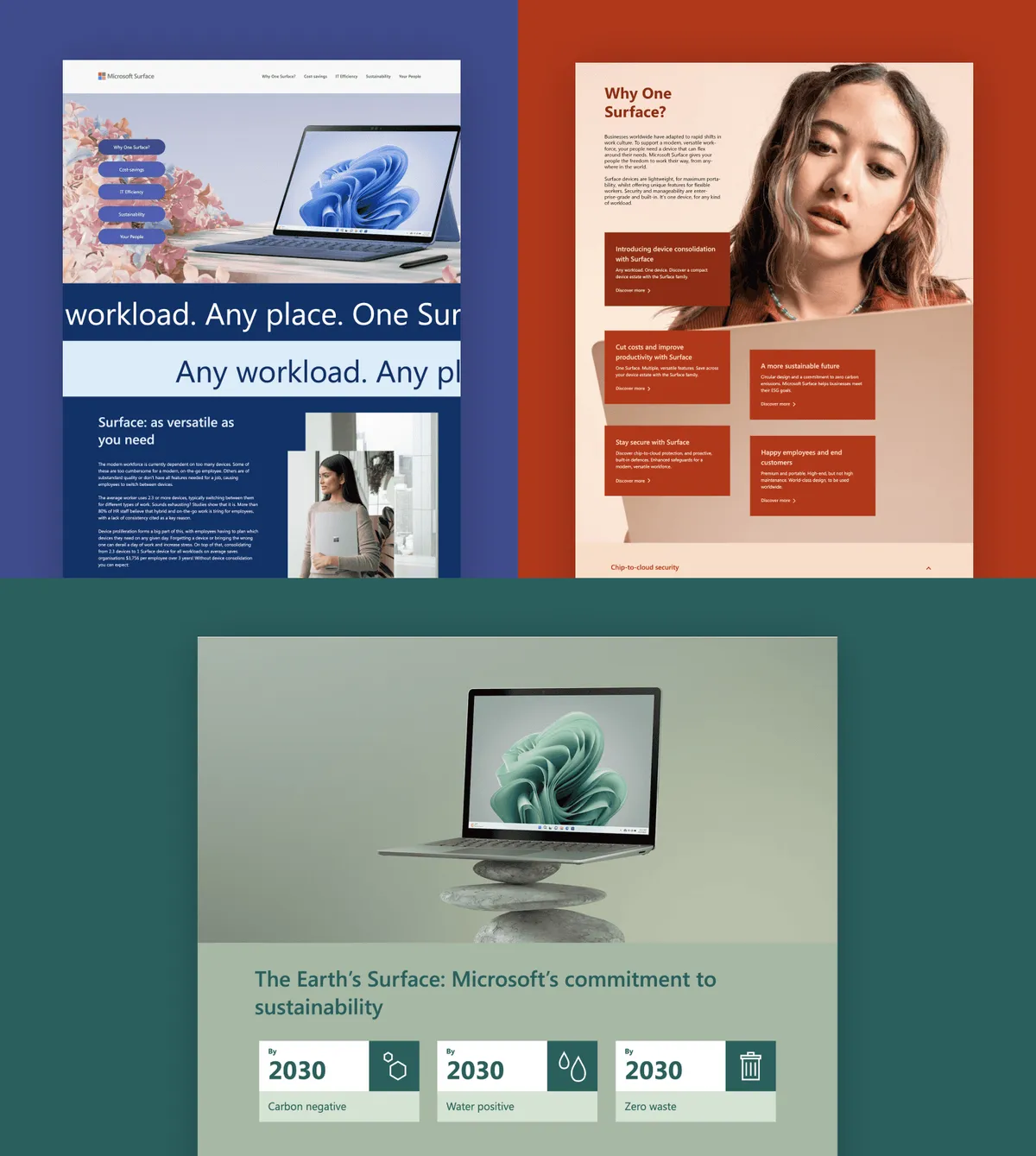
Microsoft’s Surface team wanted a hero asset that would get prospective buyers engaging with the Surface range and through to the costs page and the business cases. We built an interactive microsite, “not quite a web page, not quite an eBook”, with sections a buyer could click into, from cost savings to sustainability. It ended up as a sales tool with a lot of material for each stage of a deal, and as a showcase for new leads. The costs section was one of the best performers on the page.
Rob Stacey, then Partner Marketing Lead at Microsoft, said this about taking it to partners:
This site really raised the bar in terms of the quality of content we have taken to Partners. The copy is beautifully written, and the interactive elements are keeping prospective buyers engaged.
Rob Stacey Partner Marketing Lead, Microsoft
What I take from it for your own co-marketing is the question it answered. A buyer weighing up devices wants to know which one suits how their people work and what it will cost. The microsite answered both, so it was useful to the buyer and to whoever was selling to them.
Microsoft’s own advice to partners points the same way. In August it pointed partners to new FY27 co-op guidance on demand generation, and to research on high-growth partners that starts with investing in the moments that influence buyers (Partner Center announcements ).
A few years ago we also built partner campaigns for Microsoft UK’s Surface team, for partners selling into schools and universities (Surface partner campaigns ). Those started from the buyer’s problem too: getting affordable, capable devices to students when school and university budgets were tight. If you want the detail of how an interactive asset like the Surface one gets made, I wrote that up in a piece on lead magnets .
Got a co-marketing campaign nobody's opening?
We build interactive campaigns for Microsoft partners that answer a buyer's real question, and that a seller can use in the conversation.
Talk to usCan Microsoft partners use the Microsoft logo in co-marketing?
Not without Microsoft’s written permission. Microsoft’s trademark guidelines say not to use “Microsoft’s logos, icons, or designs, in any manner”, and not to “imply an affiliation, endorsement, sponsorship, or approval with or by Microsoft” (Microsoft trademark guidelines ). What a partner can use is the partner badge Microsoft gives it in Partner Center (Microsoft Learn ). You can also name Microsoft products in your copy to say truthfully what your offer works with, such as “built on Microsoft Azure”. The same guidelines ask you to show Microsoft’s name less prominently than your own brand, unless you have a strategic partnership agreement. Partner Marketing Center Pro also includes co-branding of its campaign assets as part of the platform.
How does co-selling fit with co-marketing?
Co-selling picks up where co-marketing leaves off, and Microsoft’s definition overlaps the two. Microsoft defines co-selling as “any collaborative engagement between Microsoft and its partner ecosystem”, and building demand is the first thing on its list, ahead of sales planning and sharing leads (Microsoft Learn ). It also says co-sell-ready status “exposes your solutions to Microsoft sales teams”.
That makes your co-marketing asset a co-selling asset too. A Microsoft seller will happily pass on something that makes them look good in front of their customer. A brochure about your company rarely does that.
If you sell through Microsoft Marketplace, Microsoft gives you some of the pieces. Its go-to-market toolkit includes badges and co-branded social assets, and its best practice guide says the documents on your listing should “educate customers, not sell to them” (Microsoft Learn ). Add ocid and UTM codes to every link you share to your Marketplace listing, and Marketplace leads from those links show up in the Referrals workspace in Partner Center, so you can see which campaign brought them in.
How do you run a co-marketing campaign with Microsoft?
Start with the buyer and work outwards to the programmes.
- Pick one solution play and one buyer. Something like “IT directors at mid-sized firms moving file shares to Microsoft 365” is specific enough to write for.
- Write down the question that buyer asks. If you can’t say it in a sentence, the campaign won’t answer it either.
- Look in Partner Marketing Center Pro first. If Microsoft has a campaign for that play, use it as the frame and save yourself the messaging work.
- Check your co-op balance and its deadline. Then check which activity your idea falls under, and what proof it needs.
- Build one thing that answers the question. A cost calculator, an assessment or an interactive guide, with your own customer proof in it.
- Tag your links and hand it to your Microsoft contacts. Your partner development manager and the account teams on your customers should see it before your buyers do.
- Turn the results into a customer story . With the customer’s agreement, it becomes the proof in your next campaign.
Enjoying this article?
Get more B2B marketing insights delivered straight to your inbox.
Thanks for subscribing!
So how do Microsoft partners run co-marketing that buyers engage with?
They start with one buyer and one question, build something useful that answers it, then use Microsoft’s programmes to pay for it and spread it. Partner Marketing Center Pro gives you a co-branded frame, co-op funds pay for the work, and co-selling puts it in front of customers Microsoft’s sales teams already know.
Microsoft gives partners a lot of help with campaigns and funding. Deciding what your buyer wants to know is still your job, and it’s where a good co-marketing strategy starts. If you’d like a hand building the asset in the middle, get in touch.